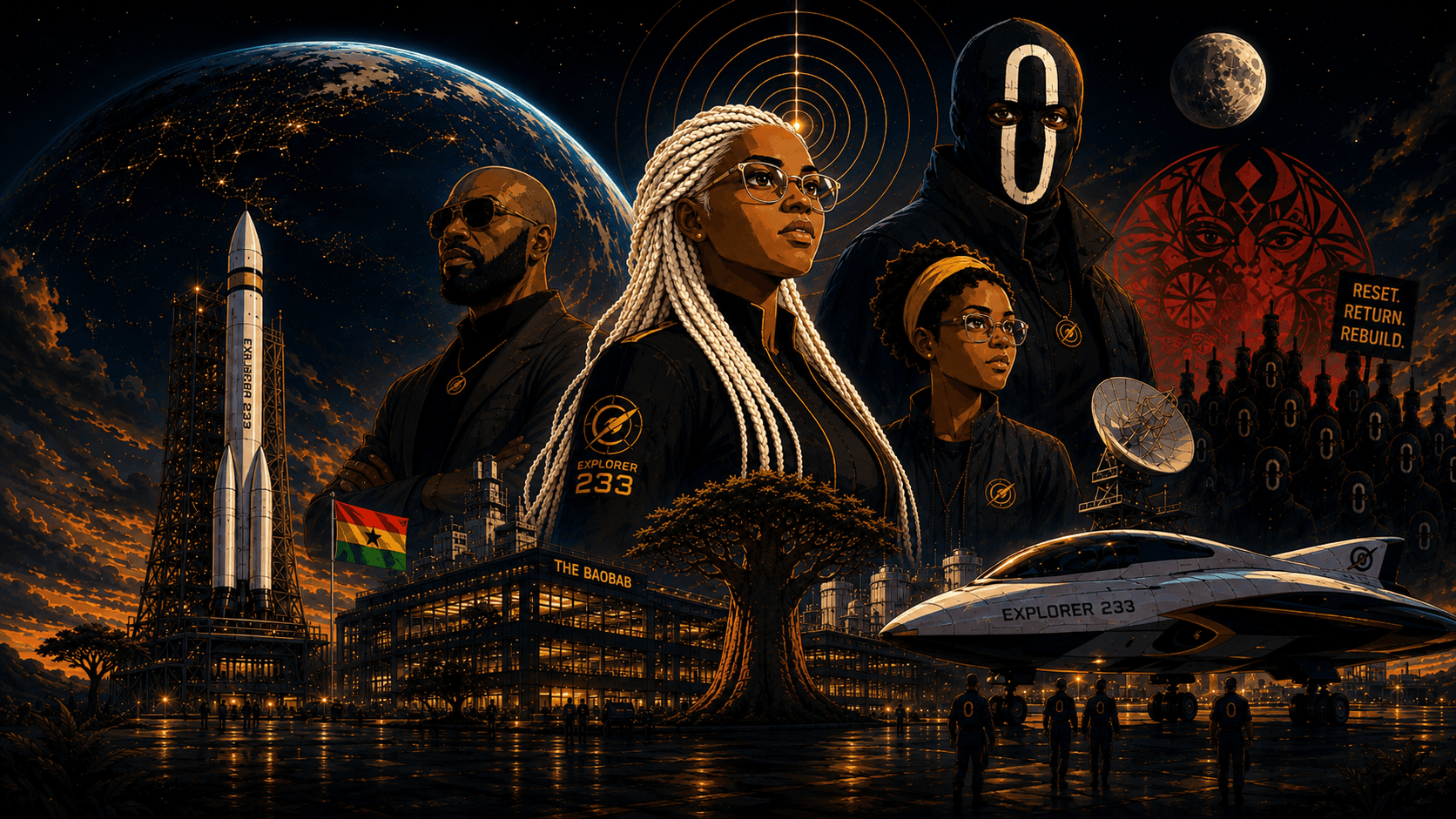
Dispatch One · SE1-01
The Grand Opening
Explorer 233 unveils its first interstellar ship in Accra. Before the night is over, someone promises to kill one of its scientists.
Mars International Research Settlement
2047
The first message from another star was discovered because Dr. Amara Nkrumah wanted tea.
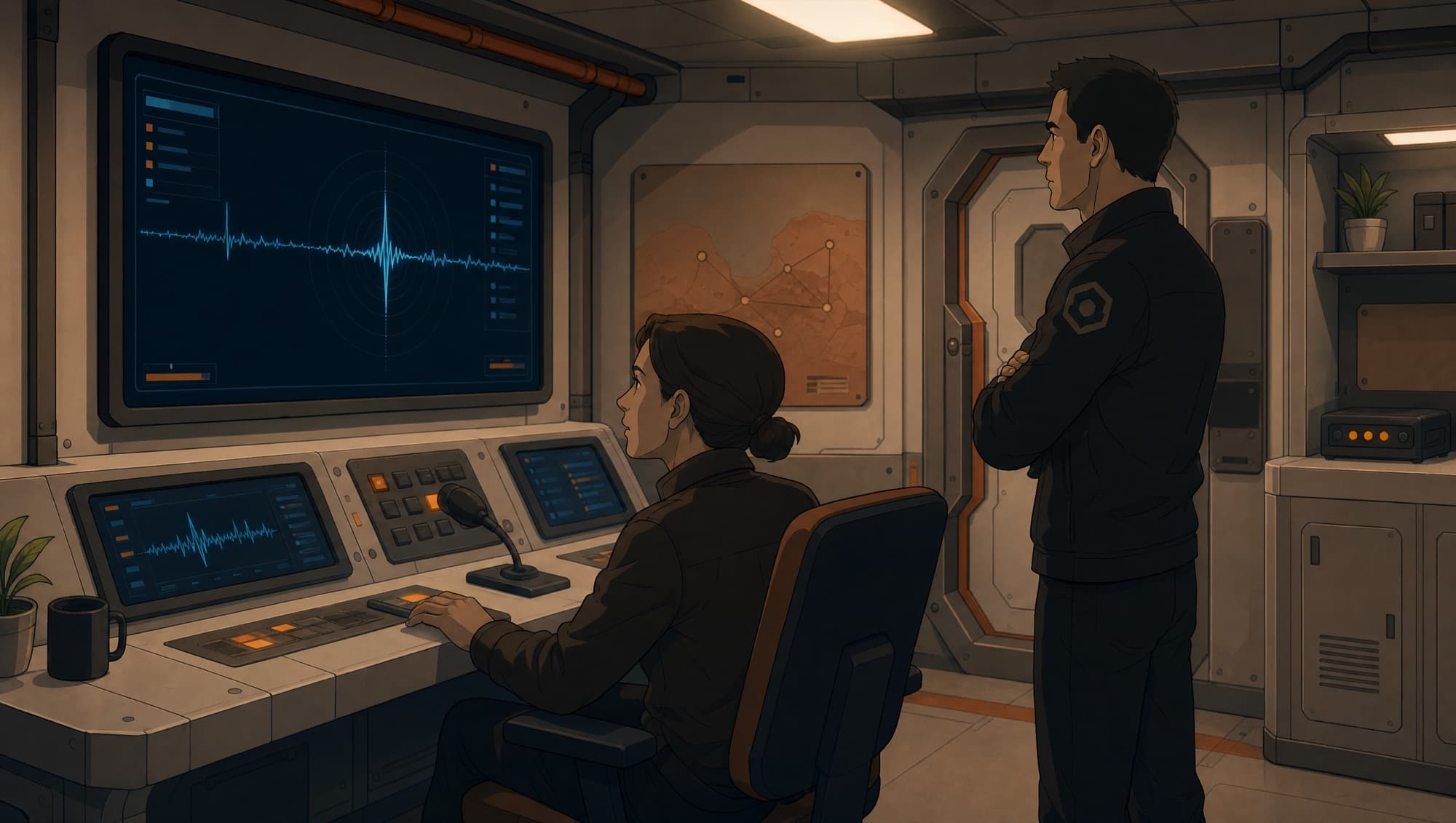
The communications room had been quiet for nearly four hours. Outside its reinforced glass, Mars pressed against the settlement in shades of rust and black. A thin storm moved over the northern ridge, dragging loose dust across the floodlights and tapping it against the habitat shell like dry rain.
Amara removed her headset and stretched until the bones in her shoulders clicked. On the largest wall display, the Earth hung as a delayed blue image beside a map of relay traffic moving between Mars, the lunar stations, the orbital platforms and the ships scattered through the inner Solar System.
Nothing about it felt miraculous anymore. Cargo schedules were late. A drilling unit had lost a wheel. The European greenhouse team was arguing with the East African nutrition unit over water allocation, and someone in Habitat Three had once again used too much bandwidth to stream a football match from Earth. Mars had become a place where people complained about work, which Amara considered humanity’s greatest achievement.
She rose from her station and crossed toward the dispenser. Behind her, Arun Dev, the youngest analyst on the night shift, was asleep with his chin resting against his chest. Commander Keiko Tanaka stood near the operations table, reading a report without moving anything except her eyes. João Pereira, systems engineer, was under a console with both legs sticking into the aisle.
The settlement belonged to no country. Flags from twenty-two nations were displayed in the main atrium, but none hung above the others. Its people had arrived through different agencies, companies and coalitions, then learned to depend on one another for air.
Amara’s tea had just begun to pour when Array Four chimed. She stopped. It was a small sound, almost polite, but when the array chimed again she abandoned the tea and turned back toward her station.
“Arun,” she said. He woke sharply and declared, “I’m awake.”
“You are now.”
Amara returned to her station, carrying the unfinished cup. A narrow pulse stood on the screen. It was too clean to be background radiation, too evenly spaced to be weather interference.
“Relay reflection?” Arun asked.
“Checking.” Amara isolated the pattern. The pulse repeated at eleven-second intervals.
João slid out from beneath the console. “Did we lose a beacon?”
“No registered beacon uses this interval,” Amara said as Commander Tanaka approached and asked for the source.
Amara widened the field, then narrowed it again. The software tried to assign the signal to a known object and failed. A second array caught the same pulse. Then a third.
The room became very still. “Could be one of the survey craft beyond Jupiter,” João said.
“No,” Amara replied.
She rotated the projection. The signal vector extended beyond the mapped traffic lanes, beyond the known probes, beyond the edge of the Solar System.
Arun leaned toward the display. “That calculation is wrong.” Amara ran it again, but the answer did not change.
A soft mechanical voice announced that Array Seven had confirmed acquisition.
Commander Tanaka looked at Amara. “Say it clearly.”
Amara’s mouth had gone dry. “The signal is not originating inside the Solar System.”
Nobody moved. Then the pulse changed.
The repeated tone broke into a sequence. The station translation systems searched for language, mathematics, navigational code, machine protocol. For three seconds, nothing appeared.
Then a line of text formed on the main display.
We are here
Arun whispered something in Hindi while João crossed himself.
Amara stared at the words. Her reflection floated faintly over them: a Ghanaian woman standing on Mars, watching humanity’s oldest question turn into a message.
“Forward it to Earth?” she asked.
Commander Tanaka did not hesitate. “Priority Alpha. Every partner government. Every deep-space network. Full verification package.”
Amara reached for the transmission control, but before she touched it Array Two chimed. A second signal appeared from a different star. Then Array Nine found another, and another.
Across the wall, points of light began appearing one after the other, until the map of nearby space looked less like a sky and more like a city waking at night.
Each source carried the same message.
We are here
Six months later — Accra, Ghana
2048
Menaye Ama Mensah woke to her brother shouting that aliens had stolen his left shoe.
“They took only one?” she called from her room.
“They want me to look foolish.”
“They travelled between stars to embarrass you before breakfast?”
Kojo appeared in her doorway wearing one sock and an Explorer 233 T-shirt that was already too small for him. At twelve, he had reached the age where every inconvenience was evidence of conspiracy.
“You moved it,” he said.
Mam looked up from the transparent display hovering over her desk. “I have more important things to do.”
On the screen, a simulation of two gravitational bodies repeatedly collapsed into each other because she had entered one decimal incorrectly. Beside it, three messages from her mother flashed in sequence.
GET DRESSED.
WE LEAVE IN FORTY MINUTES.
DO NOT WEAR THAT OLD JACKET.
Kojo pointed beneath the bed. “Is that my shoe?”
Mam glanced down. “The aliens have returned it.”
He retrieved it and left without thanking either her or the aliens.
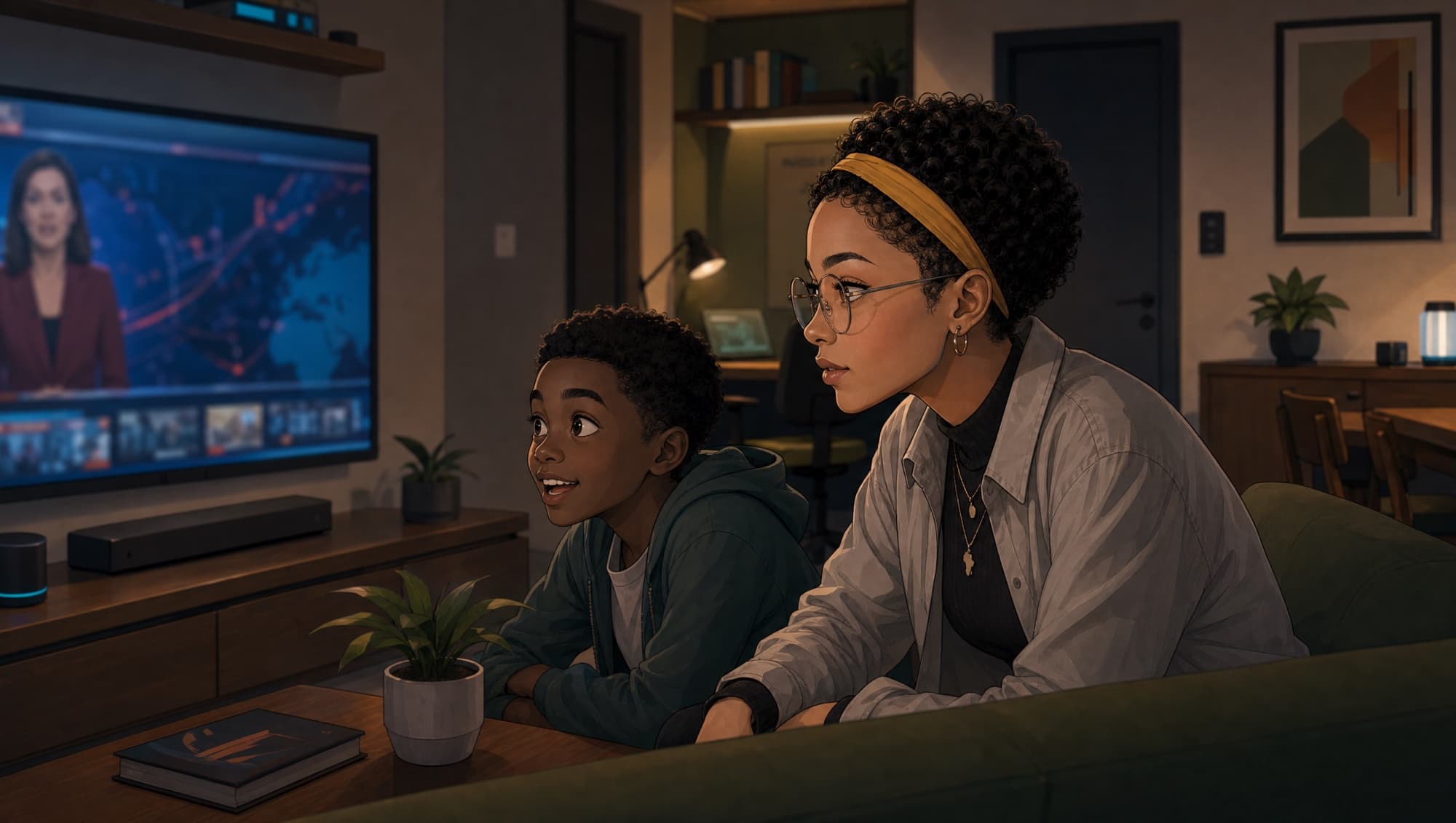
From the kitchen came the smell of fried eggs, toasted bread and pepper sauce. The morning news played from the wall display. Every channel carried footage of the Baobab: a new complex of pale concrete, warm wood and shaded glass rising on the eastern edge of Accra. Crowds had already gathered outside its gates.
Today, Explorer 233 would officially open its headquarters. For months, nobody in Ghana had discussed anything else for more than ten minutes without somehow returning to it. Was it a national triumph, a private vanity project, a research institution, a fleet, or simply a very expensive way for rich people to leave Earth before everyone else? The questions changed depending on the speaker, but everyone had an opinion.
Mam closed her failed simulation and selected a new jacket before her mother could send a fourth warning.
In the kitchen, her father was standing over a plate while reading construction reports through his glasses. Kofi Mensah had spent part of the previous two years supervising contractors at the Baobab, which meant he had answered every family question with some variation of I am not permitted to discuss that.
Her mother, Efua, placed food on the table and immediately began telling everyone to eat faster.
On the news, a commentator stood outside the Baobab beside a vendor selling miniature spacecraft, Explorer badges and black charms advertised as protection from extraterrestrial influence.
Kojo pointed at the charms. “Can I buy one?”
“No,” both parents said.
“What if the signals are dangerous?”
Efua set down a bowl. “Then a plastic necklace will certainly save you.”
The broadcaster turned to a group of protesters behind a security barrier. Some carried signs demanding that money be spent on housing and food instead of starships. Others wore black masks marked with crude white circles and held placards reading RETURN TO DAY ZERO.
Mam watched them for a moment. “They are getting more organized.”
Her father lowered his display. “Most of them are performing for the cameras.”
“And the rest?”
“The rest believe technology is the source of every human problem.”
Kojo filled his mouth with bread. “Technology gave us the signals.”
“Exactly,” Mam said.
“That was not agreement,” Kofi replied.
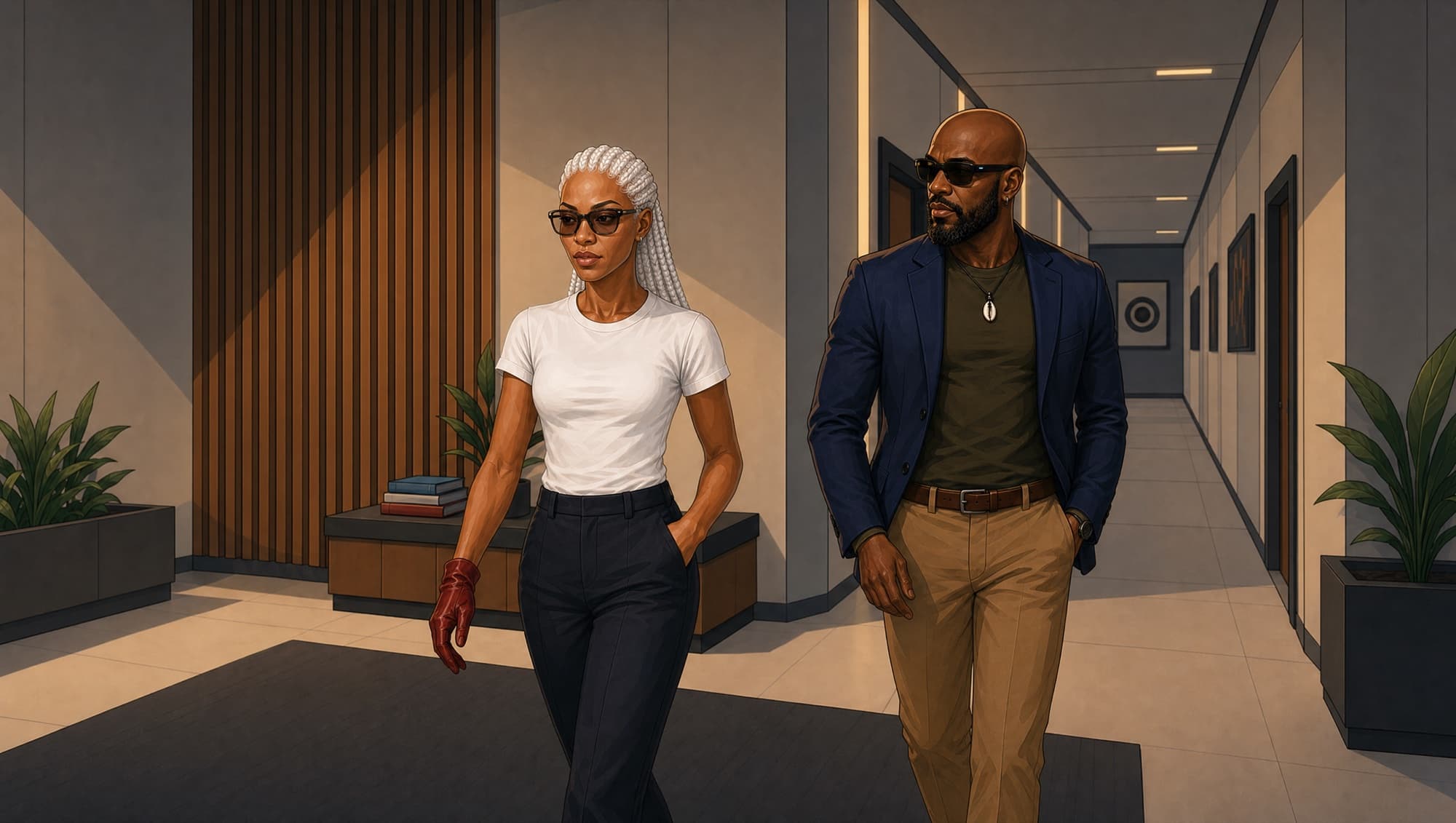
A new image appeared on the broadcast: Laura Osei Baako arriving at the Baobab before sunrise. White braids framed her face. She wore a plain white shirt beneath a dark jacket, black trousers, glasses and one black glove. Reporters shouted questions as she crossed the entrance plaza without slowing.
The caption beneath her read: LAURA OSEI BAAKO — FOUNDER, EXPLORER 233.
Mam leaned closer despite herself.
At eighteen, she had already read every public paper Laura had written, watched every interview she had given and argued online with strangers who claimed that a computer scientist had no business building an interstellar exploration program.
Laura had founded MellaniumORBIT before she was thirty, sold it for an amount no news channel could agree upon, then returned to Ghana and spent much of that fortune constructing the Baobab.
She was either one of the most important people alive or completely insane. Mam suspected both could be true.
“Eat,” her mother said, and Mam ate.
The Baobab
The road to the Baobab had become a festival.
Autonomous buses moved in controlled lines while police drones directed pedestrians away from restricted lanes. Vendors sold grilled corn, cold drinks, commemorative patches and shirts printed with the words WE’RE STAR STUFF EXPLORING THE STARS. Children carried toy spacecraft above their heads. News crews broadcast in English, Twi, French, Hausa, Arabic and languages Mam did not recognize.
Above the crowd, a floating public display replayed the first confirmed transmission from Mars.
We are here
Six months had passed since the message appeared. In that time, observatories across Earth, Mars and the Moon had confirmed signals from dozens of nearby systems. Some came from stars humanity had studied for centuries; others emerged from places where no suitable planet had been detected. Every signal carried the same three words. Nobody had answered publicly — or at least, no government admitted that it had.
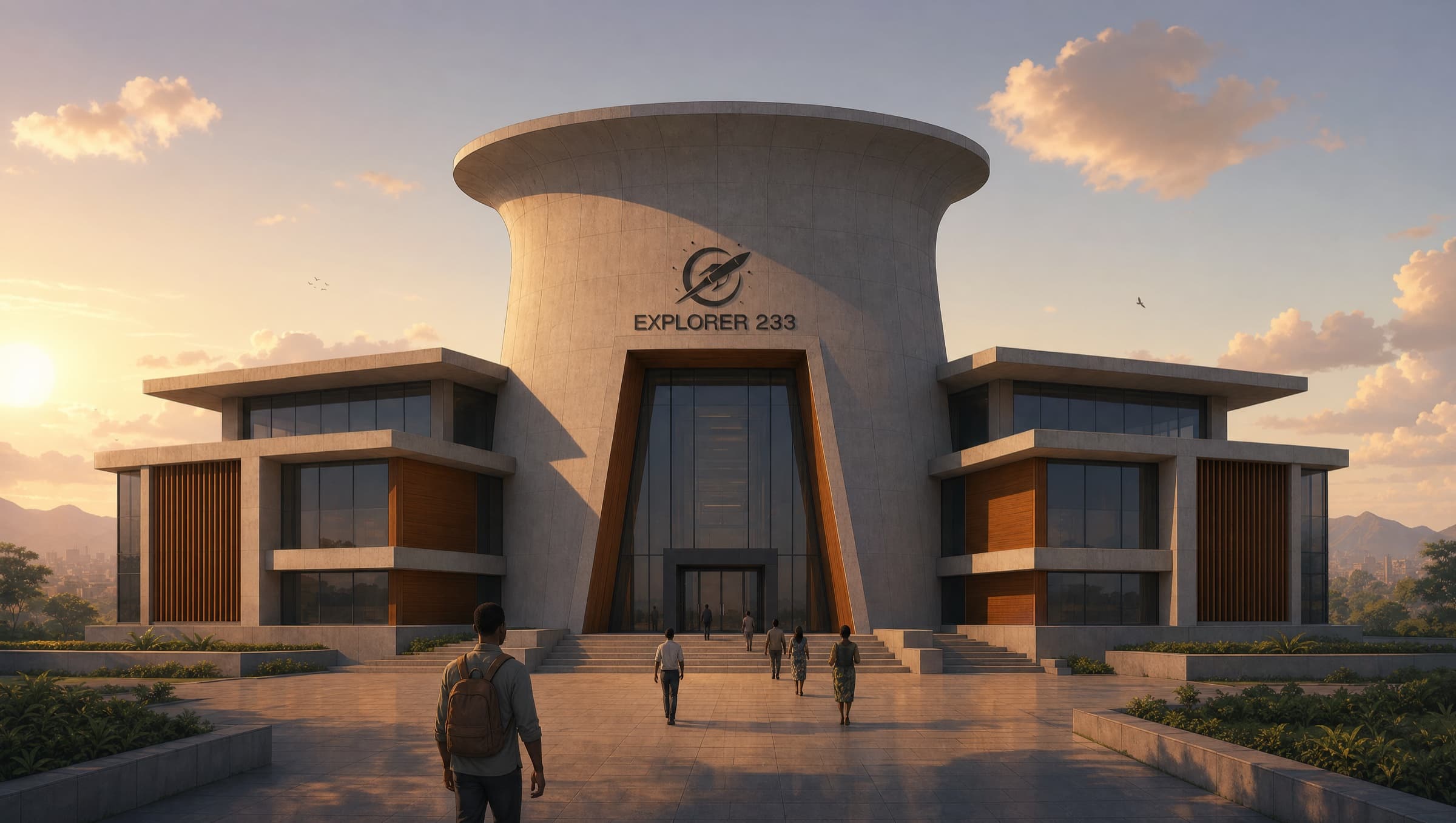
Mam’s family joined the line beneath the Baobab’s main facade. The building did not resemble the silver towers used in most space-agency propaganda. Its concrete walls curved around shaded courtyards and young trees. Deep wooden fins filtered the sunlight. The Explorer 233 emblem sat above the entrance, simple and certain.
The structure looked less like a machine than something planted.
“That section nearly delayed us by eight weeks,” her father said, pointing toward the western wing.
“You say that every time we pass it,” Efua replied.
“It remains true.”
Inside, the air was cool and smelled faintly of new wood. Staff guided visitors through exhibition halls displaying robotics, planetary habitats, navigation systems and models of orbital craft. One gallery showed Ghanaian schoolchildren remotely controlling machines in a lunar training yard. Another displayed a wall of names belonging to engineers, scientists, welders, programmers, doctors, pilots, cooks, artists and fabricators who had contributed to the project.
Mam slowed at the wall. Explorer 233 was larger than Laura and larger than the famous faces on the news. Thousands of people had built the institution now opening around her.
A voice behind her said, “People always search for the founder’s name first.”
Mam turned.
Maximus Boateng stood beside the display, wearing a dark blazer over a fitted long-sleeve shirt. He was bald, broad-shouldered and bearded, with an earring, dark glasses and a small cowry pendant at his throat. The Mission Director looked exactly as he did in interviews, except more tired.
Mam realized she had been staring. “I wasn’t searching for her,” she said.
“Good answer.”
His glasses shifted toward her father. “Mr. Mensah.”
Kofi straightened. “Director Boateng.”
“You kept the western wing standing after everyone else tried to redesign it.”
“Somebody had to.”
Maximus smiled, then looked at Mam’s visitor badge. “Menaye Ama.”
“Mam.”
“You study physics.”
Her surprise must have shown.
“Your father mentions you whenever he believes a conversation has become insufficiently difficult,” Maximus said.
Kofi looked pleased with himself. Before Mam could respond, an urgent voice spoke through Maximus’s earpiece and his expression changed almost invisibly.
“I have to go. Enjoy the ceremony.” He moved away quickly.
Mam watched him disappear through a staff entrance.
“What happened?” Kojo asked.
“Maybe aliens stole his shoe,” she said.
But Maximus had not looked amused.
Nipa Nsa
Laura stood beneath the first vessel humanity had built in Africa for travel beyond the Solar System and listened to three different people tell her the ceremony was running perfectly. This was how she knew something was wrong.
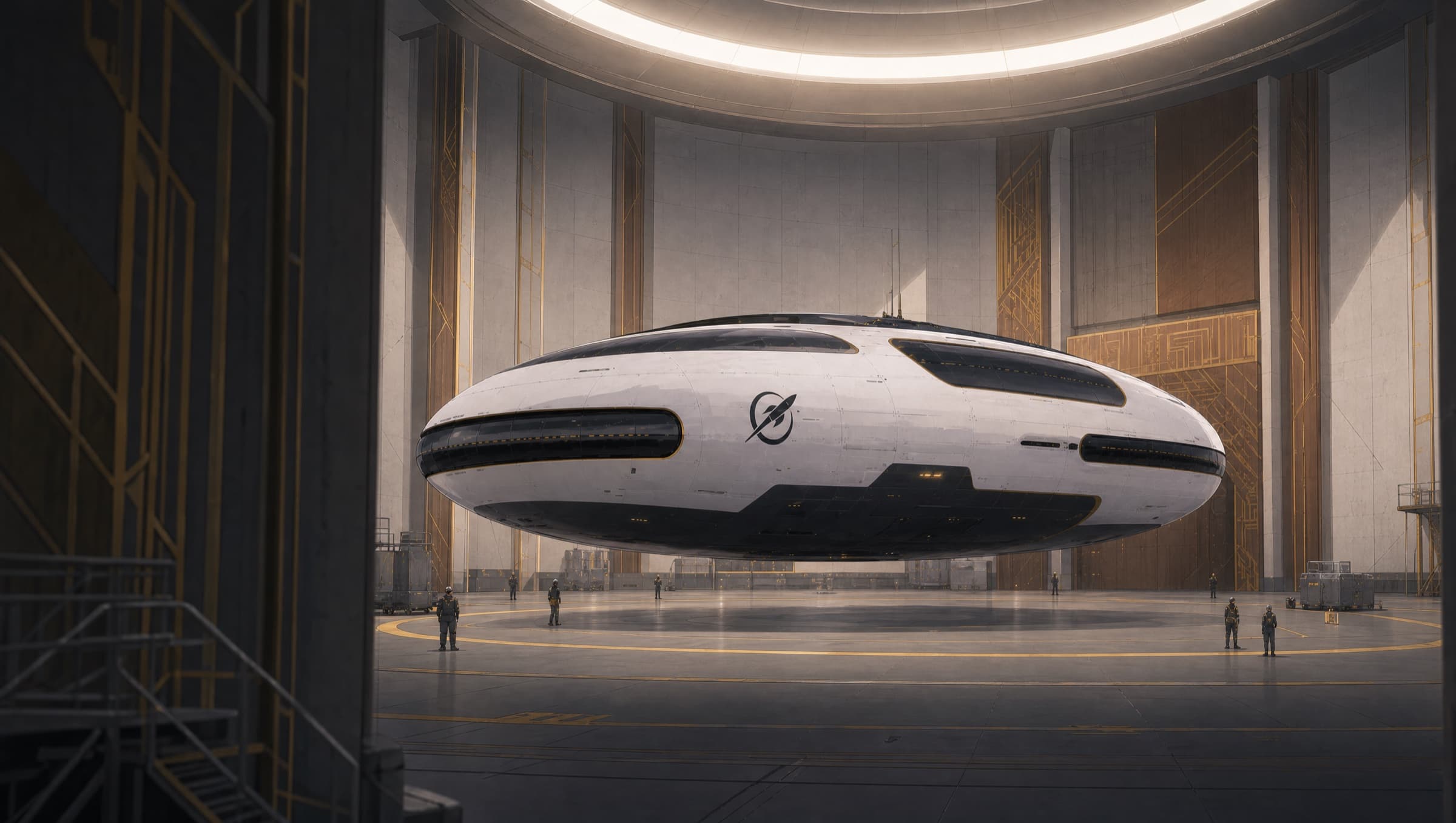
The ship occupied the central assembly chamber beyond the public galleries, hidden from the audience by an enormous segmented wall. Its hull curved overhead in dark graphite and pale ceramic, interrupted by docking ports, sensor ridges and the gold line of the Explorer emblem. The craft would never land on a planet. It had been assembled in orbit, tested there, then returned to the Baobab’s elevated cradle in sections for final commissioning and public presentation.
Soon, it would return to space and remain there. Its landing shuttles would descend to worlds, its cargo craft would move equipment, and its scouts would travel ahead while the flagship watched from orbit like a patient animal.
Along its hull, white letters read: EXPLORER 233 — NIPA NSA, EX-233-001.
The name came from an Akan proverb Laura’s grandmother had repeated whenever a task became too large for one person: one hand cannot lift a load. No single nation could lift humanity to the stars, and Laura intended to make sure Africa was not asked merely to watch.
Maximus approached from beneath the forward section.
“You were right,” he said.
“I usually am.”
“That remains statistically unsupported. Security detected an unauthorized transmission handshake in the medical research network. It disappeared before isolation.”
“Data taken?”
“Unknown.”
“System failure?”
“No.”
Laura looked toward the vessel. Technicians moved below it, completing final checks. On the opposite side of the chamber, five senior scientists waited for the procession to begin. They represented propulsion, biology, planetary systems, communications and field medicine — the first scientific leadership team assigned to the Nipa Nsa program.
“Delay the ceremony?” Maximus asked.
Laura considered it for less than a second.
“No. Lock internal systems. Double physical security around the science team. Quietly.”
“You know quiet security is a contradiction.”
“Try harder.”
A stage coordinator signaled that they had ninety seconds.
Maximus lowered his voice. “Laura, this may be nothing.”
“It may.”
“You do not believe that.”
“No.”
Beyond the segmented wall, the audience began counting down.
The commissioning
Mam had expected a speech. Instead, the lights inside the main hall faded until the ceiling became a field of stars, and the crowd fell silent.
A projection of Mars appeared above the stage. The settlement glowed on its surface, small against the planet. Then came the original pulse, the spreading signals, and the map of stars that had answered humanity without being asked.
Laura walked onto the stage alone and waited until the applause settled.
“For most of human history,” she said, “the night sky gave us only one answer: silence.”
The stars moved slowly above her.
“We filled that silence with stories. Gods. Monsters. Ancestors. Visitors. We imagined civilizations looking back at us because the alternative — that we were alone — was too large to accept.”
The words WE ARE HERE appeared behind her.
“Six months ago, the silence ended.”
Mam felt the room lean toward the stage.
“Since then, governments have competed for control of the signals. Corporations have competed for patents. Nations have begun designing missions whose findings may never be shared. Some say we should wait until the powerful decide what humanity is permitted to know.”
Laura removed her glasses. “We disagree.” A murmur moved through the hall.
“Explorer 233 was not created so Ghana could own the stars. No country can. It was created because humanity will reach them, and Africa must arrive as a builder — not a passenger.”
The applause came harder this time. Mam’s father stood first, Kojo shouted loudly enough to embarrass the entire family, and Efua wiped at one eye and denied doing so. Laura waited again.
“Today is not the unveiling of one ship. It is the commissioning of an exploration fleet.”
The wall behind her began to separate, and light poured through the opening as the segmented panels withdrew to reveal the vessel suspended in the chamber beyond. For one long moment, nobody made a sound.
The Nipa Nsa was not shaped like the sleek rockets of old science fiction. It was broad through the center, with a reinforced spine, rotating habitat sections and smaller craft locked beneath its hull. It looked built to carry people far from home and keep them alive there.
Then the hall erupted, and Mam forgot to breathe.
Across the vessel’s surface, displays illuminated its name and designation. Other silhouettes appeared above it: future hulls, specialist ships, cargo vessels, survey craft and emergency support platforms. Crew recruitment. Scientific missions. Training programs. Planned routes.
It was a fleet not yet complete, but already imagined.
Maximus joined Laura onstage. Behind them came the scientists, engineers and mission teams. The crowd applauded every person without knowing which names would later become famous and which would be remembered for terrible reasons.
Laura lifted one hand.
“The first destination of the Nipa Nsa will be selected from the signal systems after final review. We will travel to a designated departure zone beyond Earth orbit. There, the vessel will activate the Mellanium Field and enter what our engineers call the Current.”
A dark river of stars formed above the ship as Laura continued. “We will not promise that the journey is safe. We will not pretend we understand what waits at the other end. Exploration has never required certainty. It requires preparation, courage and the humility to know that discovery changes the discoverer.”
Her gaze moved across the hall. “To everyone asking whether Africa is ready for this moment, I offer a different question.” The room quieted.
“If we keep waiting for permission, who will write the future while we wait?”
This time, the applause felt like weather.
Near midnight
The celebration continued into the evening.
Visitors filled the courtyards. Music rose from the plaza. Children queued to enter shuttle simulators while adults argued about the cost of the program beside tables serving jollof, waakye and drinks named after planets.
Mam recorded three versions of a video before keeping the least awkward one.
“Today Explorer 233 officially commissioned the Nipa Nsa, the first vessel in a planned exploration fleet—”
Kojo pushed his face into the frame.
“Aliens, we are coming!”
Mam stopped recording. “You ruined it.”
“I improved it.”
A notification flashed across her glasses. Someone had shared her earlier footage of the unveiling. Thousands of people were already arguing beneath it.
Fraud. Historic. Colonial fantasy. African future. Waste of money. Take me with you.
The future had arrived and immediately become a comment section.
Across the courtyard, Laura stood surrounded by ministers, investors and foreign delegates. She smiled when required, listened when useful and escaped whenever possible. Maximus remained near the science team, scanning the crowd through his dark glasses.
One of the scientists — a soft-spoken biologist named Dr. Samuel Tetteh — left the group after receiving a message. Maximus noticed and followed him with his eyes.
Mam noticed Maximus noticing.
Then her mother called her to a family photograph, and the moment passed.
Near midnight, the Baobab finally became quiet.
Cleaning machines moved through the halls. Security teams completed sweeps of the galleries. The Nipa Nsa rested in darkness behind the transparent chamber wall, lit only by maintenance lamps along its hull.
Laura stood alone in her office, barefoot now, her red shoes abandoned beside the desk. Accra glittered beyond the glass.
The day’s messages covered one wall: congratulations from presidents, requests from universities, offers from corporations and threats from anonymous accounts. One file sat apart from the rest. It had no sender, no routing history and no detectable entry point.
Laura called Maximus.
He answered immediately. “I’m two floors below.”
“Come up.”
“What is it?”
“I don’t know yet.”
She opened the file before he arrived.
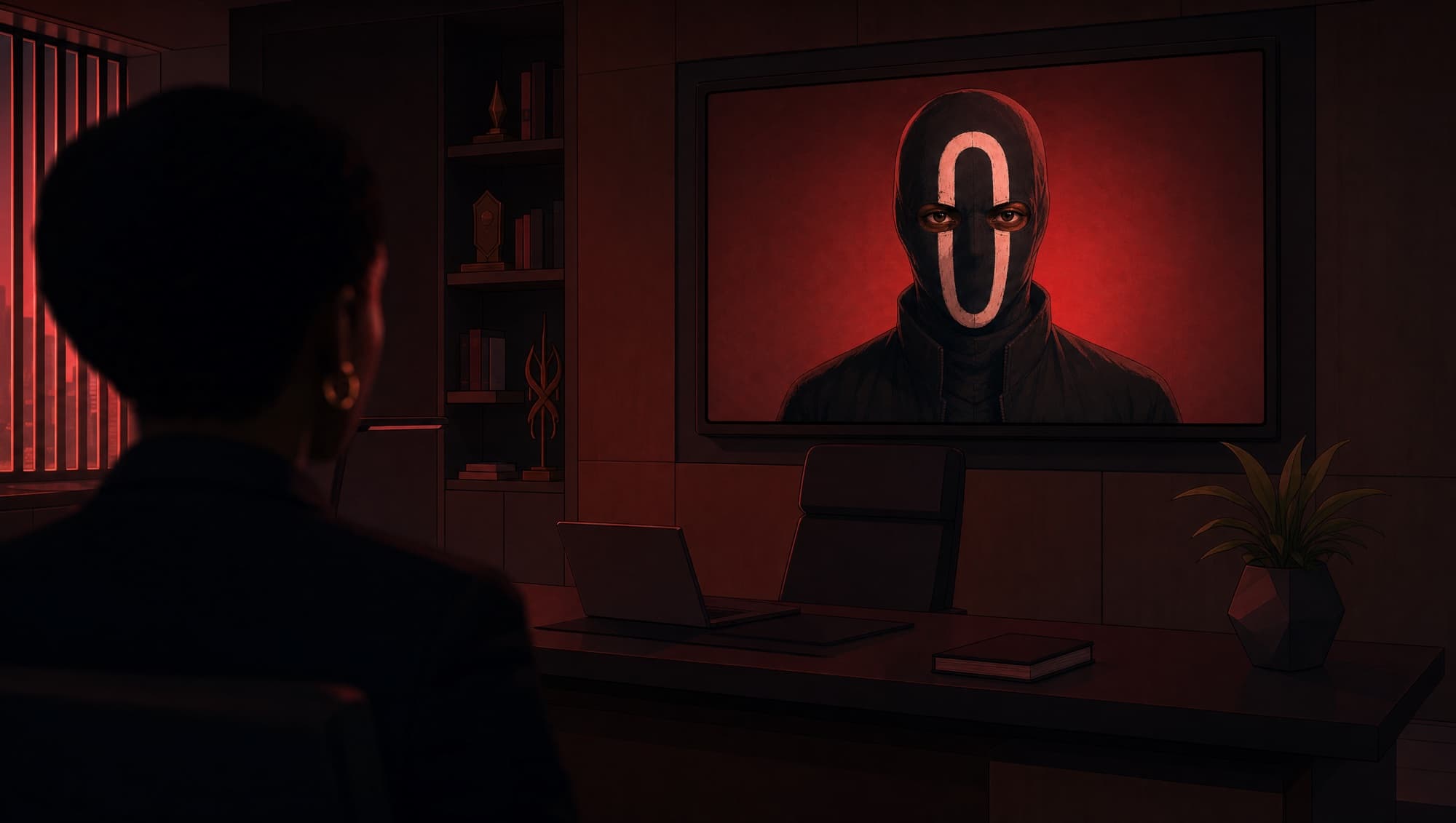
The screen went black. For several seconds, nothing happened. Then a figure appeared.
The person wore a close black mask. A single white zero stretched from the forehead toward the mouth. Two white circles surrounded the eyes.
Behind the figure stood others wearing the same face.
No electronic distortion covered the voice. It sounded calm, almost ordinary.
“Laura Osei Baako.”
Laura did not move.
“You opened your Baobab today and invited the world to worship tomorrow.”
The figure tilted its head. “You believe every new machine is progress. You believe distance will save humanity from the consequences of what it has become. You call your invasion exploration.”
A white symbol appeared over the image: a circle drawn in one unbroken line.
“We remember the world before the machines learned our names. Before the sky filled with stations. Before human pride reached for other suns.”
Laura heard the office door open behind her. Maximus entered, saw the screen and stopped as the masked figure continued.
“The return begins now.”
Images flashed across the screen — security photographs of the five senior scientists who had stood onstage beside Laura.
One face appeared after another: Dr. Samuel Tetteh, Professor Lindiwe Okafor, Dr. Idris Bello, Dr. Sena Adjei and Dr. Hana El-Masri. Then the images disappeared.
“Within twenty-four hours,” the figure said, “one of your scientists will die.”
The video ended. For a moment, Laura and Maximus stood in the reflection of the black screen. Then Laura put her shoes back on.
“Seal the building,” she said.
Maximus was already speaking into his earpiece.
Far below them, beneath the sleeping Baobab, the Nipa Nsa waited to be returned to the sky.
And somewhere in Accra, a man who had never met Laura Osei Baako was preparing to kill for Day Zero.
End of Dispatch SE1-01
The opening is over.
The threat has begun.
Next dispatch in
Arriving September 7, 2026
Join Explorer 233 for new dispatches, project news, events and member benefits.
Join Explorer 233